
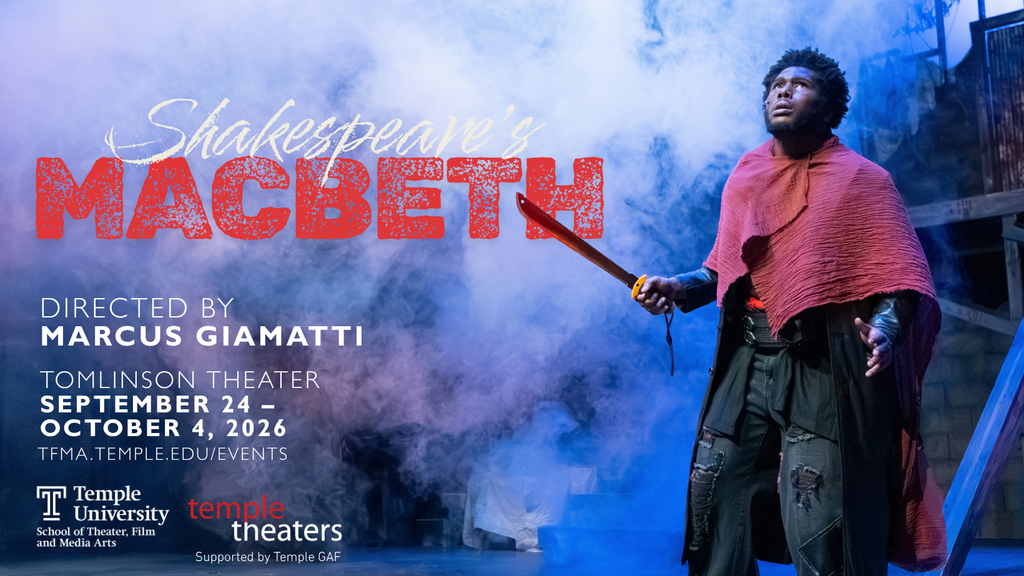
Temple University’s upcoming production of Macbeth is set in a dystopian future, but why?
And more importantly, why can’t the name be said in a theater?
By Morgan Ritter
Before Mad Max, there was Macbeth.
Considered one of William Shakespeare’s most iconic tragedies, the story of Macbeth follows the titular noble general in his power-hungry and murderous quest to take and keep the Scottish throne. As opposed to what one might recall from high school English class, the Temple University theater department’s production, running Sept 24 - Oct 4 ) is set in a bleak, dystopian future after a global apocalypse.
[Get Tickets here -- Temple Student Tickets just $12]
Post-apocalyptic and dystopian media surged in popularity over the last few decades, with movie sagas like Mad Max and The Hunger Games and video game franchises like Fallout and The Last of Us. One constant remains throughout this genre, which is the struggle for resources in the wake of tragedy, and even more so, the necessity to resort to violence. But that violence doesn’t come without consequences.
Macbeth is centered around violence and how perpetrators must deal with the results, starting with a battle against a rebel leader and ending with a battle between a different rebel leader and a tyrannical king. Macbeth believes he must kill to keep his reign, but it ultimately drives him to paranoia and insanity.
The dystopian genre also deals heavily with a lack of hope for a better future. Characters are often simply surviving, not even bothering to hope that humanity might go back to the way it was before societal collapse. Similarly, Macbeth greatly fears the future, with a witches’ prophecy weighing so heavily on his mind that his competition’s children will be kings instead of his own.
Outside of the plot, Macbeth is feared greatly among theater buffs, thanks to the renowned curse associated with the production.
At the time Macbeth was first written, King James VI of Scotland rose to the throne of England as King James I. Before his rise to the throne, James VI’s mother, Mary Queen of Scots, was executed, and two years later, James and his wife nearly drowned at sea. These events are said to have sparked his obsession with witchcraft, which he brought to his reign in England.
It is likely that Shakespeare was heavily inspired by this aspect of James, injecting into the story of Macbeth through the characters the “Weird Sisters”, who are witches that prophesized Macbeth’s fate. It is also possible that some of the spells and ingredients were from real spells researched by Shakespeare.
Supposedly, when the play first opened in the early 17th century, real-life witches highly objected to the show’s portrayal of witchcraft. The show was then plagued with many unfortunate incidents, including the death of the actress playing Lady Macbeth; hence, the alleged curse.
Fast forward to the mid-19th century and a rival between two touring companies showing Macbeth ended in a shooting. The working-class fans of Philadelphian actor Edwin Forrest’s production stormed famous British actor William Charles Macready’s production at the Astor Place Opera House in New York. A riot ensued, the militia was called in, and they proceeded to open fire in the crowd resulting in 22 deaths. Macbeth curse or class struggle? A little bit of both, perhaps? It is also said that the curse causes theaters that perform Macbeth to shut down, but this is often because it is put on by already-struggling theaters, and the cost of production is typically quite high. Even saying “Macbeth” in a theater is often forbidden—it is common to hear cast and crew simply call it “the Scottish play” to ward off any risk of curse.
Hopefully the fact that this production of Macbeth is already set after the "end of the world" will allow the curse to pass over Temple University’s theater department.
Come see it if you dare!
Performances run until Oct. 4, 2026.
(Thanks to Camden Westfall for Dramaturgy)