
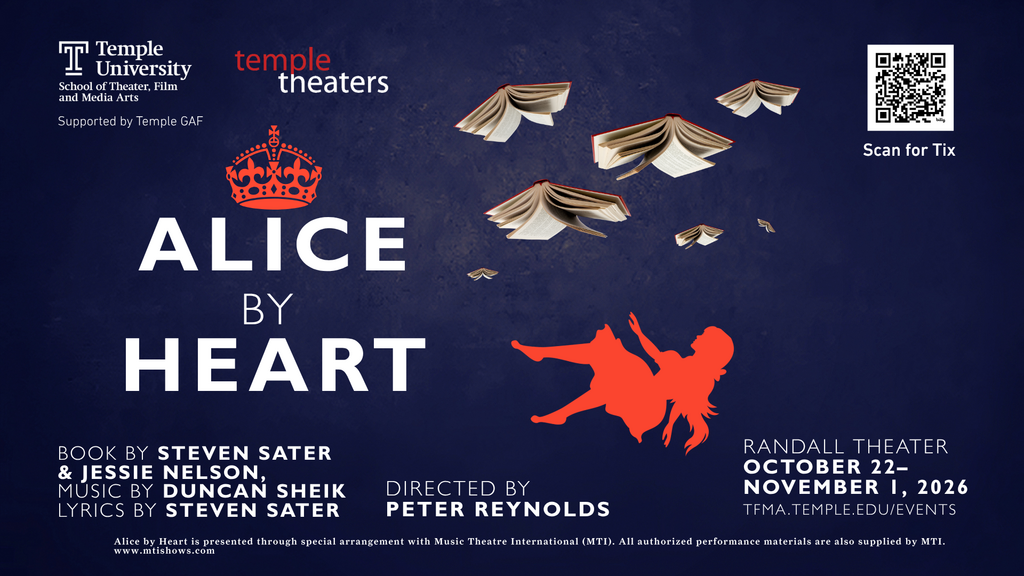
From the artists who made Spring Awakening
Alice By Heart displays the difficulties of growing up in the most explosive way possible.
Coming of age can feel like a bomb going off. Combine that with the actual threat of a bombing raid and that’s where the story of Alice by Heart begins.
In its second theatrical production of the academic year, Temple University’s theater department will be showcasing an unconventional portrayal of Lewis Carroll’s iconic story Alice’s Adventures in Wonderland; but it is not a direct adaptation of the work.
“It's more so taking the familiar environments and characters and using it as a backdrop to explore the effects of war and trauma, illness, puberty, self-acceptance, courage, and all these really important coming-of-age themes but told through these very palatable characters that are very recognizable household names,” said dramaturg Adam Tornielli.
The musical follows teenager Alice Spencer and her best friend Alfred as they take shelter in an underground tube station during the London Blitz of World War II. When Alfred is suddenly quarantined with tuberculosis, Alice begins to recount her favorite story, Alice’s Adventures in Wonderland, from memory (or “by heart”) as a way for the pair to mentally escape their situation.
The setting is gritty, traumatic, and terrifying: the perfect landscape to portray the complexities of growing up.
“At this time, the United Kingdom was being suppressed by a force that wasn't even on their home turf,” said Tornielli. “So [Alice] is rationalizing with being suppressed and being traumatized by this force that is greater than herself, and she's forced to comply with these harsh conditions that no child should have to.”
Carroll’s original Wonderland is all about nonsense and rebelling against it. The outrageous characters are meant to poke fun at these greater rules that we have to follow as a society and authority figures that we have to appeal to, Tornielli said.
Alice and Alfred are joined by an ensemble of characters hunkered down in the station with them, who morph into characters from Wonderland as Alice retells the tale. One of them is a controlling Red Cross nurse who oversees everyone in the station, who Alice turns into the Queen of Hearts.
“When she meets the Queen of Hearts and has to appeal to the authority figure, the Queen of Hearts is just as foolish and just as outrageous, but she has to learn to stand up for herself and poke holes in the Queen’s argument, despite no one being behind her.”
While she stands strong in her defiance, she eventually must face the latter part of all coming-of-age stories: accepting change.
“Alfred is the sick young man, but in Wonderland, he gets to walk again, he is useful, able-bodied,” said Tornielli. “But it's not sustainable. It's a lifestyle that is running away from his true problems and responsibilities. So, he is able to grapple with the fact that he has to go back to being a kid who is surrounded by the unfair circumstances that he was dealt and he helps Alice also come to terms with that.”
Alice by Heart was written by the team of Duncan Sheik (who tragically passed away this past month) and Steven Sater, who famously wrote the rock musical Spring Awakening in 2006. The show was incredibly nontraditional at the time, not just for its themes of teenage sexuality, but also for using a standard rock band rather than a pit orchestra. Alice by Heart follows a similar instrumentation that amplifies the themes of rebellion.
“She lives a very cruel and unfair life that any little girl shouldn't be forced to live, and yet she is so resilient,” said Tornielli. “She recites Alice in Wonderland by heart as this act of defiance, and one could say that this is how she learned what protest is. I think that if an audience leaves saying this young girl is able to stand up against these greater forces of evil, especially in such an uncertain time in United States history, I think that is a job well done.”
If you want to go down the rabbit hole, buy tickets here -- Don't be late (like the White Rabbit) - Tickets are going fast!
Performances run Oct. 22 through Nov. 1, 2026.
(Many Thanks to Adam Tornielli for dramaturgy.)